Ten Years with Home Assistant
It’s hard to believe that I’ve been running Home Assistant in one form or another for close to a decade. What started as a weekend experiment with a Raspberry Pi hiding behind our media cabinet has grown into the quiet operating system for our house. These days it keeps an eye on mail deliveries, reminds me to close the garage, and even makes sure the car doors get locked if I forget.
Dashboard #
Here’s my current dashboard view (security camera feeds are blocked for privacy, but you get the idea):
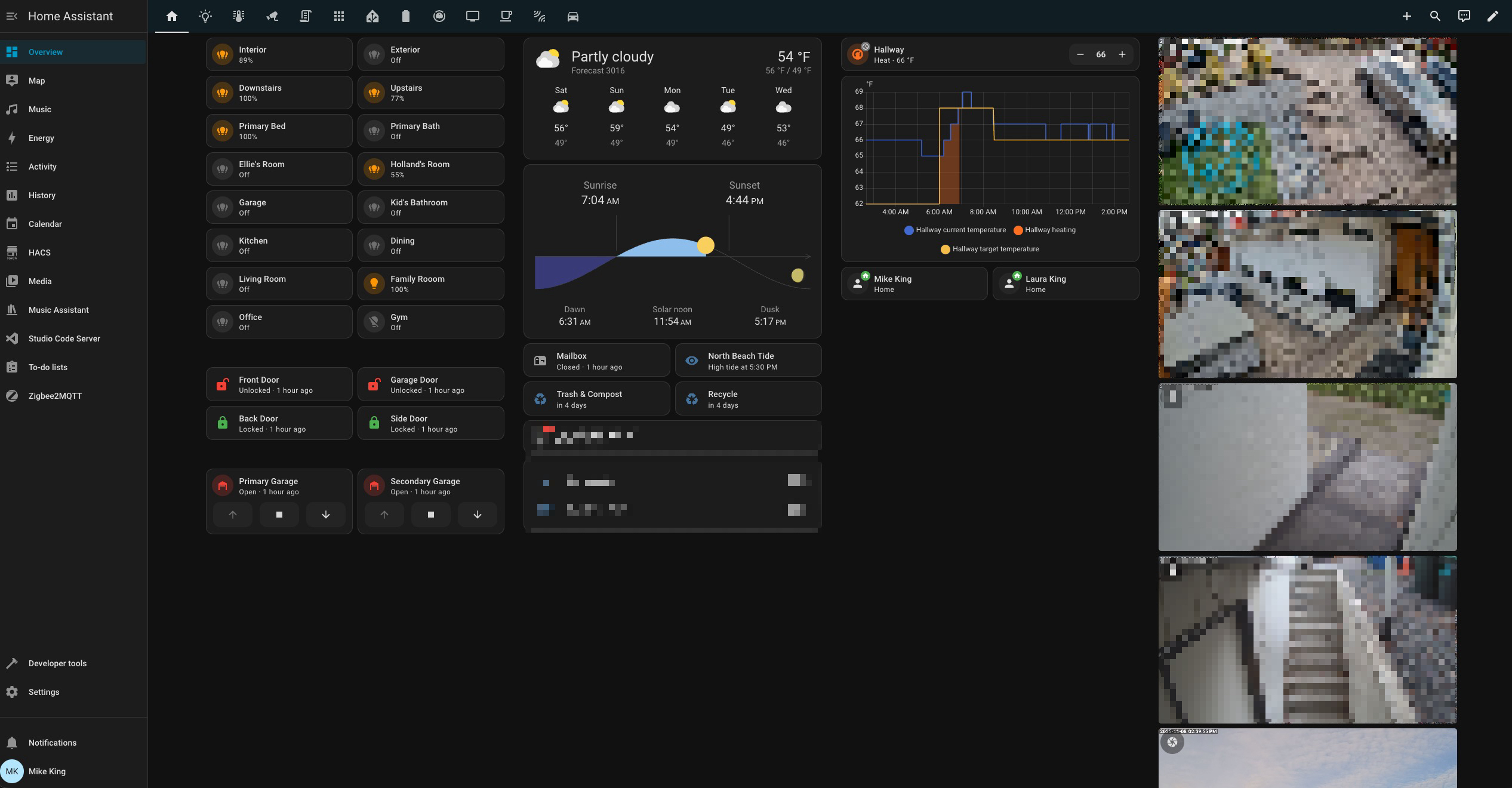
Cards for lights, media, security, and presence keep the important stuff on one page. I keep iterating on the layout and it has evolved over the years.
Automations #
Over ten years I’ve accumulated more scenes and scripts than I’d like to admit, here are a few of my favorites:
- Mail notification – A small Zigbee contact sensor on the mailbox tells Home Assistant when the door opens. Between 11 a.m. and 5 p.m. it pings my phone so I know when to make the trek to the curb.
- Garage + car failsafe – Every night at midnight a “Lock cars" automation runs. If our vehicles report any door unlocked, Home Assistant sends the remote lock command and closes the garage for good measure.
- Dinner Time – A scene that pauses the Peloton, fades the living room lights to 40%, and puts Sonos on an easy playlist so the whole house shifts gears at once.
- Motion everywhere – Nearly every utility space—laundry, storage, the sauna, even the primary closet—has a motion recipe that handles lights with custom sun-elevation rules. It sounds trivial, but never having to touch a switch in the middle of the night and having it only turn on to 20%.
- Fan & vanity babysitters – Bathrooms have occupancy timers that cut power to outlets and fans after twenty minutes. They’ve saved more than a few curling irons and kept humidity in check.
- Sonos reset – At 4 a.m. every day Home Assistant un-groups any stray speakers and drops volumes to a sane level. No more surprise 100 dB wake-up calls when someone accidentally leaves a speaker cranked.
- Morning exhaust routine – At 8 a.m. every fan in the house kicks on for ten minutes to clear the air after showers and coffee.
Lessons #
- Keep naming human. “💡 Motion Lights – Primary Shower (Night Light Mode)” makes it easy to debug.
- Automate confirmations. Any critical action (locking doors, closing the garage) gets a follow-up sensor check so I never assume something happened just because a command was sent.
- Layer redundancy. Double turn-off automations at 8:11 and 8:22 look silly, yet they ensure unattended fans or heaters don’t stay on.
Here’s to the next decade of tinkering. If you’re experimenting with Home Assistant too, I’d love to swap ideas.